2026-06-14
Making Retrieval Smarter
Part 8 of a from-scratch series on Retrieval-Augmented Generation. First-pass retrieval is fast but only roughly right: the best chunk can sit at rank six. Sharpen it with three levers, in pipeline order. Before retrieval, transform the query (multi-query, HyDE, step-back, decomposition). During retrieval, filter by metadata. After retrieval, rerank a wide candidate set with a cross-encoder and keep the best few. Includes a focused code addition that adds reranking and a metadata filter to the app you built in Part 6.
What you’ll learn
In Part 7 we made retrieval recall-strong with hybrid search, and we ended with an uncomfortable truth: the ranked list it returns is only roughly right. The chunk that best answers the question might sit at rank five or six, below something that merely looks relevant. This part is about sharpening that list. You will get a clean mental map of the three places you can intervene around retrieval, called levers here: before it (rewrite the query), during it (filter the candidates), and after it (rerank the results). You will learn why a fast first pass is structurally imprecise, what a cross-encoder is and why reranking with one is the highest-leverage fix, and you will add a reranking step and a metadata filter to the app from Part 6 in a few lines.
Prerequisites
Parts 1 through 7, especially Embeddings (Part 2), Vector Databases and Indexing (Part 4), and Retrieval Deep Dive (Part 7). You should be comfortable with embeddings, cosine similarity, top-k, and the idea of hybrid (dense plus sparse) retrieval. Basic Python is enough for the one code section.
Where Part 7 left us, and three levers to pull
Part 7’s closing advice was a strategy: cast a wide net, then trim. Retrieve generously so the right chunk is somewhere in the net, accepting that the order will be imperfect, then tighten things up afterward. That advice quietly admitted a problem we never fixed: first-pass retrieval is fast but imprecise. It is very good at “these twenty chunks are in the right neighborhood” and only mediocre at “this exact chunk is the single best answer.”
Good news: every weakness here has a named, well-understood fix, and they fall naturally into three positions around the retrieval step. I will call them the three levers, and we will pull them in pipeline order:
- Before retrieval, the BEFORE lever: query transformations. The user’s raw question is often a poor search query. Rewrite it into something the index can match well.
- During retrieval, the DURING lever: metadata filtering. Constrain the search to chunks that satisfy hard criteria (right customer, right date, right section) before you ever score them.
- After retrieval, the AFTER lever: reranking. Take the wide, roughly-ordered candidate set and reorder it with a slower, far more accurate model, then keep only the best few.
Keep that map in your head for the whole chapter: improve the query going in, narrow the field, then sharpen the order coming out. Reranking is the star, so let us first understand precisely why we need it.
Why retrieval is only “roughly right”: the bi-encoder bottleneck
The retrieval you built in Part 6 and tuned in Part 7 uses a bi-encoder: the query and each chunk are embedded separately into vectors, and relevance is the cosine similarity between them. The “bi” is the whole point. There are two independent encoding passes that never see each other. The chunk is embedded once, offline, when you build the index; the query is embedded on its own at search time; then you compare two finished vectors with cheap arithmetic.
That design is what makes retrieval fast enough to be useful. Because every chunk vector is precomputed, answering a query is one embedding plus a nearest-neighbor lookup, even across millions of chunks (Part 4). Speed is the gift.
The cost is precision, and it is structural, not a bug you can tune away. Each text, however long and nuanced, gets crushed into a single fixed-length vector before it has any idea what it will be compared against. The chunk vector cannot emphasize the part of the chunk that happens to matter for your question, because it was computed long before your question existed. The query vector cannot lean on a specific phrase in a specific chunk, because it is built in isolation too. Two summaries are compared, never the full texts side by side. So a chunk that shares surface vocabulary with the query (say, both mention “jacket”) can score higher than the chunk that actually answers the question but happens to phrase it differently. The ranking is plausible, not precise.
That looseness is exactly the gap reranking closes, and it is why the rest of this chapter exists.
The BEFORE lever: query transformations
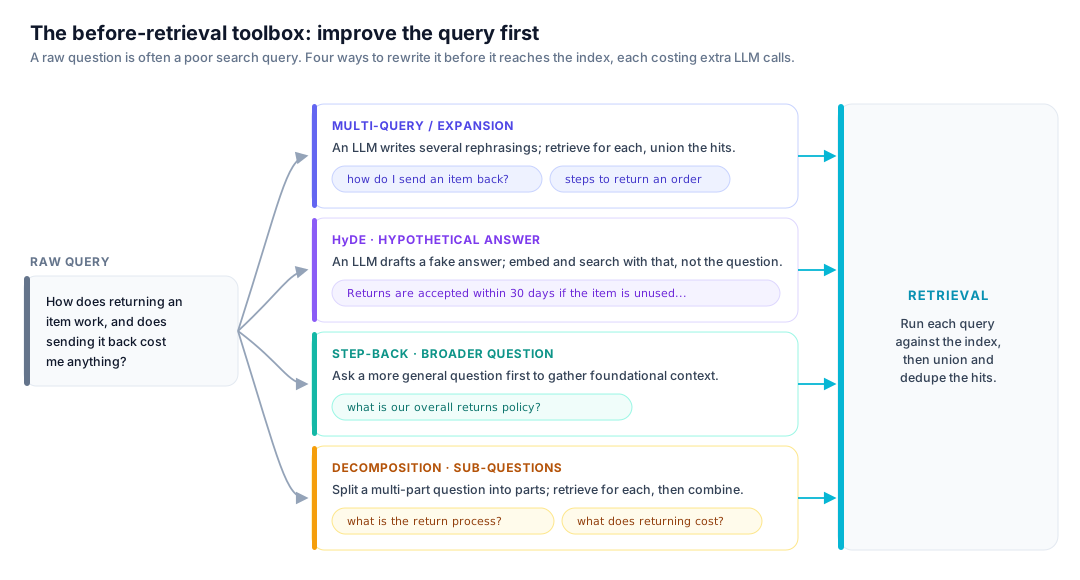
Before a query ever reaches the index, you can improve it. Users do not write search queries; they write questions, and questions are often short, ambiguous, conversational, or secretly several questions at once. A query transformation rewrites the raw question into one or more better search queries. Every technique below buys quality with extra language-model calls, which means more latency and more cost, so reach for them where a class of query keeps failing, not by default.
Here are the four worth knowing.
Multi-query, also called query expansion. Ask a language model to produce several rephrasings of the question, retrieve for each one, then union the results and remove duplicates. Different phrasings surface different chunks, so this mainly lifts recall: it widens the net so the right chunk is less likely to be missed because the user’s exact words did not match.
HyDE (Hypothetical Document Embeddings). Instead of searching with the short question, ask a language model to write a hypothetical answer to it, then embed that and search with it. It sounds backwards, but it works for a clean reason: a passage that answers a question looks far more like the real target documents than a terse question does, so its embedding lands closer to them in vector space. The caveat is real. The model can hallucinate a confidently wrong “answer” and steer retrieval off course, and it adds a call, so treat the hypothetical as a search probe, never as content you would show the user.
Step-back prompting. Generate a more general, more abstract version of the question and retrieve for that first, to gather the foundational context a specific question needs. Asked “is a worn linen blazer covered,” a useful step-back query is “what is our overall returns policy.” It helps reasoning-heavy questions where the specific answer depends on background the narrow query would never pull in.
Query decomposition. Split a complex, multi-part question into sub-questions, retrieve for each, then combine the results. “How does returning an item work, and does it cost anything” is really two questions; answering it well means retrieving for both. Decomposition is essential for compositional queries, and it is a first taste of the agentic patterns in Part 10, where the system plans its own sub-questions.
The DURING lever: metadata filtering
Back in Parts 4 and 5 we were careful to keep metadata on every chunk: its source, date, author, section, document type, and, in real systems, who is allowed to see it. The DURING lever is where that pays off. Metadata filtering constrains retrieval to only the chunks that match hard, non-negotiable criteria, so the similarity search runs over a smaller, cleaner pool. Only 2024 documents. Only this customer’s files. Only chunks from the “pricing” section.
Why bother, when similarity search already ranks things? Four reasons:
- Precision. A filter removes confidently-irrelevant matches outright, instead of hoping a low score buries them. The semantically-similar 2019 policy simply cannot appear if you filter to the current year.
- Freshness. A date filter is the simplest way to keep stale documents from competing with current ones. Embeddings have no sense of time; metadata does.
- Security and multi-tenancy. This one is not optional. In a shared system, an access-level filter is what stops one user’s query from ever retrieving another user’s documents. Treat this as a hard correctness and safety requirement, not a nice-to-have. It is so important that we devote Part 12 to doing it properly.
- A smaller, cheaper search space. Fewer candidates means faster, cheaper retrieval, which matters at scale.
One distinction to file away. Pre-filtering applies the metadata constraint before the similarity search, so you score only the chunks that already passed. Post-filtering runs the similarity search first and then drops the hits that fail the filter. Pre-filtering is usually what you want, because it scores only the matching chunks, so you get the top-k of the matching set and never waste scoring on chunks you will throw away. The catch with post-filtering is that it can quietly return fewer than k results, or none, even when plenty of matching chunks exist, because it filters a list that was already trimmed to the top overall matches. (Pre-filtering can return fewer than k too, but only in the honest case where fewer than k chunks match the filter at all.) Many vector databases support proper pre-filtering directly; use it.
The AFTER lever: reranking with cross-encoders
This is the chapter’s star, and it directly attacks the bi-encoder bottleneck from earlier.
A cross-encoder takes the query and one candidate chunk together, as a single joined input, and outputs one number: how relevant this chunk is to this query. Because both texts go through the model at once, every word of the query can attend to every word of the chunk, and the other way around. The model is not comparing two pre-baked summaries; it is reading the pair and judging the match directly. That is why a cross-encoder is dramatically more accurate at relevance than a bi-encoder. It is also why reranking, reordering candidates by a cross-encoder’s score, fixes exactly the looseness we diagnosed. The contrast is easiest to see side by side.
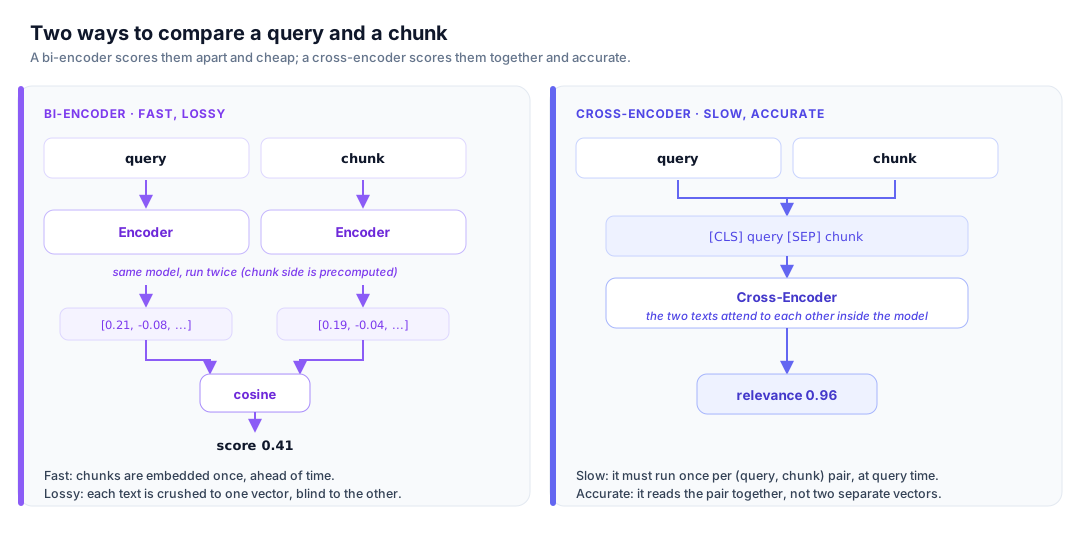
So why not rerank everything and skip the bi-encoder entirely? Because a cross-encoder is slow in exactly the way the bi-encoder is fast. It cannot precompute anything: the score depends on the query, so the model has to run once for every (query, chunk) pair, at query time. Running it across millions of chunks for a single search would take minutes and cost a fortune. It is wonderful at judging a short list and hopeless as a first-pass search over a whole corpus.
That tension has a clean resolution, and it is the headline pattern of this part: two-stage retrieval, also called retrieve-then-rerank.
- Retrieve wide (fast). Use the bi-encoder or hybrid search from Part 7 to fetch a generous candidate set, say the top fifty to one hundred chunks. This stage’s job is recall: get the right chunk into the net, order be damned.
- Rerank narrow (accurate). Run the cross-encoder on just those candidates, reorder them by its relevance score, and keep the best few, say the top three to five. This stage’s job is precision: surface the genuinely best chunk to the top.
You get the bi-encoder’s speed over the whole corpus and the cross-encoder’s precision over the short list, and you only pay the expensive model on a few dozen pairs. This is Part 7’s “cast a wide net, then trim,” now with a name and a mechanism: the wide net is stage one, the cross-encoder does the trimming. The animation below makes the reorder concrete. We ask about a refund on a worn jacket, watch first-pass retrieval return ten candidates with the genuinely best one stuck at rank six under an off-topic sale ad, then trigger the rerank and watch the order snap into shape, with a cut line marking the top-k that actually reaches the model.
A practical note, with the usual freshness caveat. There is a healthy supply of ready-made rerankers: open cross-encoder models you can run locally and hosted reranking APIs you call over the network. Reranking models, their APIs, and the recommended model names move fast and I have a knowledge cutoff, so I will keep the code that follows minimal and lean on the local cross-encoder. Check the current docs for today’s best model and exact usage before you ship.
Reranking is a family, not one model
It is tempting to read “reranker” as “the ms-marco-MiniLM cross-encoder” and stop there, because that is the one the code below uses. Do not. The pointwise cross-encoder (score one query-chunk pair, sort by the scores) is the oldest and simplest member of a much larger family, and the rest of the family is where most of the recent gains have come from. Three things are worth keeping in your head.
The hosted APIs have moved well past the 2019 baseline. If you do not want to host a model, several vendors sell reranking as a single network call, and as of this writing the current generations are larger, longer-context, and multilingual. Cohere’s Rerank 4 line (a pro and a fast variant) carries a 32k-token context window and 100-plus languages. Voyage’s rerank-2.5 and rerank-2.5-lite are instruction-following, meaning you can steer relevance with a sentence (“prefer documents that cite primary sources”) instead of only a query, also at 32k tokens. The names and numbers here will be stale by the time you read this, which is exactly the point: check the current docs rather than trusting any single model name baked into a tutorial.
The open models are competitive and you can run them yourself. You are not forced onto an API to get past the old MiniLM. Mixedbread’s mxbai-rerank-v2 (a 0.5B base and a 1.5B large, Apache-2.0) and the bge-reranker-v2 family are open cross-encoders you can download and serve; the BGE rerankers in particular have become a common, easy-to-deploy baseline. These behave like the local model in the code below: a pair goes in, a relevance score comes out, you sort.
Listwise and LLM rerankers change the shape of the problem. A pointwise cross-encoder scores each candidate in isolation, so it never sees that candidate two and candidate five say nearly the same thing, or that candidate three only makes sense given candidate one. A listwise reranker instead reads the query and several candidates together and produces an ordering over the whole set, which lets the comparisons inform each other. Jina’s jina-reranker-v3, for example, is a listwise model that processes a batch of documents in one long-context pass. The most flexible version of this idea is to hand the query and the candidate list straight to a general-purpose language model and ask it to rank them: an LLM reranker. It is the most capable and by far the most expensive option, since you pay full generation cost per query, but for low-volume, high-stakes ranking it can beat every dedicated model. The throughline: “rerank” spans a cheap pointwise cross-encoder, a mid-cost listwise model, and a full LLM judge, and the right choice is a budget decision, not a default.
The candidate-set knob
The two-stage pattern has a single most important tuning lever, and it is not the reranker model. It is n, the size of the candidate set you hand from stage one to stage two. Everything else in this chapter is secondary to getting this number right, for one blunt reason: a reranker can only reorder what it is given. If the chunk that answers the question is not in stage one’s top-n, no reranker, however good, can surface it. It was never in the room. Reranking improves precision (the order of the candidates); it does nothing for recall (whether the right candidate is present at all). Recall is fixed entirely upstream, by n.
So the quantity to watch, and the one Part 11 will teach you to measure, is stage-1 recall@n: across your real queries, how often is the genuinely correct chunk somewhere in the top-n that the first pass returns. That number is the ceiling on your whole pipeline. If recall@50 is 90 percent, then 10 percent of your queries are already lost before the reranker runs, and a better reranker buys you nothing on them. The fix for those is a bigger n, or a better first stage (the hybrid search from Part 7), not a fancier reranker.
Which pushes you to make n large. The counter-pressure is cost, because n is exactly the number of pairs the cross-encoder has to score, and that brings us to the latency budget.
A pointwise cross-encoder runs once per candidate, at query time, so its cost is roughly linear in n. Concrete, order-of-magnitude numbers for a small MiniLM-class model: reranking 50 to 100 candidates adds on the order of 30 to 200 ms to a query, and the spread is mostly hardware. On CPU, scoring 50 to 100 pairs typically lands in the low hundreds of milliseconds; on a GPU the same work drops under about 50 ms, and a big accelerator can do 100 pairs in the low tens of milliseconds. Batching the pairs (scoring them in one forward pass rather than a loop) is where most of the throughput comes from, so always pass the whole candidate list to predict at once, never one pair at a time. Push much past 100 to 200 candidates and the rerank starts to dominate your latency, which is the practical reason n usually settles in the 50-to-100 range: large enough to make recall@n high, small enough that the cross-encoder stays cheap. Hosted reranking APIs hide the hardware but bill per document scored, so the same arithmetic applies, just denominated in dollars.
The takeaway is a tuning loop, not a fixed answer: raise n until recall@n is comfortably high on your own queries, then stop, because every extra candidate past that is latency and cost the reranker spends reordering chunks that were never going to win.
Putting the levers together
Here is the enhanced query-time pipeline with all three levers in place, in order:
- Transform the raw query (the BEFORE lever): rephrase, expand, or decompose it if this kind of query needs it.
- Filter by metadata (the DURING lever): restrict to the right tenant, date, or section. Security filters are mandatory.
- Retrieve wide (the bi-encoder cosine first pass; in production, the hybrid search from Part 7): pull a generous candidate set so recall is high.
- Rerank that set with a cross-encoder (the AFTER lever) and keep the top few.
- Generate: hand only those best chunks to the model, with the grounded prompt from Part 6.
The crucial caveat: you almost never need all three levers at once. Each one adds latency, cost, and moving parts. The discipline is to add a lever where your failure analysis demands it, not because it sounds advanced. If your misses are mostly stale or cross-tenant results, you need a filter, not a reranker. If the right chunk is reliably in the top fifty but rarely at the top, a reranker is your fix. Part 11 is entirely about measuring retrieval so you make these calls with evidence instead of vibes. For now, hold the principle: measure before you add complexity.
Extend the app: add a reranker and a filter
Time to make this real on the app from Part 6. We will add a metadata filter and a cross-encoder reranker around retrieval. This is an extension, not a rebuild: embedding, storing, augmenting, and generating are all unchanged. We give each chunk a little metadata, fetch a wide first-pass set, and rerank it down to the top-k. (Reranker model names move fast; verify the current one.)
from sentence_transformers import CrossEncoder

# A cross-encoder scores a (query, chunk) PAIR directly. Check current names.
reranker = CrossEncoder("cross-encoder/ms-marco-MiniLM-L-6-v2")

def rerank(query, candidates, top_k=3):
    pairs = [(query, c["text"]) for c in candidates]   # one pair per candidate
    rel = reranker.predict(pairs)                       # a relevance score per pair
    ranked = sorted(zip(candidates, rel), key=lambda cr: cr[1], reverse=True)
    return [{**c, "rerank": float(s)} for c, s in ranked[:top_k]]  # keep the best few, with their score

def smart_retrieve(query, n=10, top_k=3, where=None):
    candidates = first_pass(query, n=n, where=where)    # Part 6 retrieve, but wide
    return rerank(query, candidates, top_k=top_k)        # then the accurate trim
The first_pass function is just Part 6’s retrieve asked for a larger n (ten here, where a real corpus would fetch fifty to one hundred; our toy corpus only has ten chunks), optionally narrowed by a metadata filter. Run the query “Can I get a refund on a jacket I’ve already worn?” and print the order before and after reranking:
QUERY: Can I get a refund on a jacket I've already worn?

STAGE 1, first-pass order (bi-encoder cosine, top 10):
   1. 0.71  Our winter jacket collection is on sale through the end of the month.
   2. 0.66  Refunds are accepted within 30 days of purchase, provided the item is unused.
   3. 0.52  To start a return, email support@example.com with your order number.
   4. 0.49  Items marked final sale cannot be returned or exchanged.
   5. 0.44  Exchanges for a different size are free within the return window.
   6. 0.41  Worn or washed clothing counts as used and is not eligible for a refund.
   7. 0.37  Shipping fees are non-refundable; late returns get store credit.
   8. 0.33  Gift cards never expire and are non-refundable.
   9. 0.21  Standard shipping takes 3 to 5 business days; express is next-day.
  10. 0.18  All electronics include a one-year limited warranty.

STAGE 2, after cross-encoder rerank (top 3 kept):
   1. 0.96  Worn or washed clothing counts as used and is not eligible for a refund.
   2. 0.88  Refunds are accepted within 30 days of purchase, provided the item is unused.
   3. 0.74  Items marked final sale cannot be returned or exchanged.
Look at what happened. On the first pass, an off-topic sale ad ranked first because it shares the word “jacket,” and the chunk that actually answers the question (“worn clothing counts as used”) was stranded at rank six, below the cut a naive top-three would have taken. The cross-encoder, reading each chunk together with the query, lifts that decisive chunk to the top and drops the sale ad near the bottom. The model now receives the three chunks that genuinely settle the question, so it can answer correctly instead of being misled. (Both the first-pass ordering and these scores are illustrative and depend on the embedding and reranker models you pick. The local reranker above actually outputs an unbounded relevance logit, not the tidy 0 to 1 numbers shown here, so your live run will look different. Only the resulting order is the point.)
The metadata filter is the other half. Because each chunk carries a section, you can restrict the first pass to the returns policy and the sale ad never even competes:
With a metadata filter (section == "returns"), the sale ad never even competes:
   1. 0.66  Refunds are accepted within 30 days of purchase, provided the item is unused.
   2. 0.52  To start a return, email support@example.com with your order number.
   3. 0.49  Items marked final sale cannot be returned or exchanged.
The complete, runnable file is here: rag_rerank.py. It builds straight on Part 6’s rag_app.py, so augment and generate carry over untouched.
Recap, and the road ahead
We took the roughly-right ranked list from Part 7 and sharpened it with three levers around retrieval. Before, we rewrite the query (multi-query, HyDE, step-back, decomposition). During, we filter candidates by metadata, with security filtering as a hard requirement. After, the star of the chapter, we rerank a wide candidate set with a cross-encoder, the two-stage retrieve-then-rerank pattern that finally puts Part 7’s “cast a wide net, then trim” on a real mechanism. With a reranker and a filter, a single-pass pipeline is about as sharp as it gets.
And yet it is still single-pass: it retrieves once and generates once, and we never questioned what unit we retrieve. Every part so far has handed the model whichever chunks scored well, exactly as they were stored. But the best thing to retrieve and the best thing to show the model are not always the same chunk. That is the subject of Part 9.
Try it yourself
The fastest way to feel why the candidate-set knob matters is to turn it yourself. Open rag_rerank.py and run it once as-is to see the stage-1 and stage-2 orders side by side. Then poke at it:
- Vary
n(the wide-net size) and watch which chunks survive into stage two. Callsmart_retrieve(query, n=3, top_k=3)and thensmart_retrieve(query, n=10, top_k=3). With the decisive “worn clothing” chunk sitting at rank six in the first pass, a smalln(say 3 or 5) cuts it off before the reranker ever sees it, and no reordering can bring it back. Widennand it reappears in the candidate set, and the rerank lifts it to the top. That is recall@n becoming the ceiling, made concrete on ten chunks. - Vary
top_k(how many survive the rerank) and watch the cut line move. Keepnwide and steptop_kfrom 1 to 5. This does not change which chunks the cross-encoder scores, only how many you keep for the generator: it is the precision end of the knob, separate from the recall end above. - Swap the reranker model. The code hard-codes
cross-encoder/ms-marco-MiniLM-L-6-v2. Change that one string to another local cross-encoder (abge-rerankerormxbai-rerankcheckpoint) and rerun. The absolute scores will look completely different (recall the MiniLM model emits unbounded logits, not 0-to-1 numbers), but the order is what to compare. Seeing two different models agree on the winner, or disagree, is the cheapest possible intuition for why model choice is a real decision and not a detail.
⚠️ Common pitfalls
- Cross-encoders silently truncate long chunks. Every reranker has a max input length, and the query plus chunk are concatenated into that one budget. If a chunk is longer than the limit, the model quietly cuts off the tail and scores only what fit, so the part of the chunk that actually answers the question may never be read. There is no error, just a wrong score. Keep chunks comfortably under the model’s max tokens, or reach for a long-context reranker, and never assume the whole chunk was judged.
- Reranking cannot fix a stage-1 recall miss. This is the candidate-set knob restated as a failure mode. If your misses are queries where the right chunk was not in the top-n at all, a better reranker is wasted money: it only ever reorders what stage one handed it. Diagnose first (Part 11), then either widen
nor improve the first stage. Do not reach for a reranker to fix a recall problem.- Multi-query times reranking multiplies cost. The BEFORE lever and the AFTER lever interact badly if you are not careful. If multi-query fans one question into five rephrasings and you retrieve n candidates for each, your reranker now scores up to 5n pairs, not n. Dedupe the unioned candidate set before the rerank, and cap the total pairs you feed the cross-encoder, or the two “advanced” techniques quietly multiply your per-query latency.
Key takeaways
- First-pass retrieval is only roughly right because it uses a bi-encoder: query and chunks are embedded separately, so each text is crushed to one vector that never gets to consider the other. Fast, but structurally imprecise.
- Sharpen retrieval with three levers in pipeline order: before (transform the query), during (filter by metadata), after (rerank the results).
- Query transformations (multi-query, HyDE, step-back, decomposition) turn a poor question into better search queries. Each costs extra LLM calls, so use them where a query type keeps failing.
- Metadata filtering enforces hard criteria (date, section, and critically, access level for security and multi-tenancy) and shrinks the search space. Prefer pre-filtering, which scores only matching chunks, over post-filtering, which can return fewer than k results even when plenty of chunks match.
- A cross-encoder scores the query and a chunk together and judges relevance far more accurately than a bi-encoder, but it is too slow to run over a whole corpus.
- “Reranker” is a family, not one model: a cheap pointwise cross-encoder (open ones like
bge-rerankerandmxbai-rerank, or hosted APIs like Cohere Rerank 4 and Voyagererank-2.5), a mid-cost listwise model that ranks several candidates together, and a full LLM judge. The choice is a budget decision. - The most important knob is n, the candidate-set size, because a reranker can only reorder what it is given. Tune recall@n (is the right chunk in the top-n at all) upstream; reranking only fixes order, never recall. A small cross-encoder adds roughly 30 to 200 ms to rerank 50 to 100 candidates, mostly hardware-dependent.
- Two-stage retrieval (retrieve-then-rerank) resolves the tension: retrieve a wide net fast, rerank it with the cross-encoder, keep the best few. Add levers only where your failure analysis demands it; measure before adding complexity (Part 11).
References
- Nogueira, R., & Cho, K. (2019). Passage Re-ranking with BERT. arXiv:1901.04085. arxiv.org/abs/1901.04085: the monoBERT cross-encoder that established the retrieve-then-rerank pattern: feed the (query, passage) pair through BERT together and read off a single relevance score.
- Gao, L., Ma, X., Lin, J., & Callan, J. (2022). Precise Zero-Shot Dense Retrieval without Relevance Labels. arXiv:2212.10496. arxiv.org/abs/2212.10496: HyDE: generate a hypothetical answer with an LLM and search with its embedding instead of the short question’s.
- Zheng, H. S., Mishra, S., Chen, X., Cheng, H.-T., Chi, E. H., Le, Q. V., & Zhou, D. (2023). Take a Step Back: Evoking Reasoning via Abstraction in Large Language Models. arXiv:2310.06117. arxiv.org/abs/2310.06117: step-back prompting: derive a broader, more abstract version of the question to gather the foundational context a narrow query would miss.
Glossary
- Bi-encoder: a model that embeds the query and each chunk separately into vectors and compares them with cosine similarity. Fast, because chunk vectors are precomputed, but lossy, because each text is summarized into one vector in isolation. This is ordinary dense retrieval.
- Cross-encoder: a model that takes the query and a candidate chunk together as one input and outputs a single relevance score. Far more accurate than a bi-encoder, because the two texts attend to each other, but slow, because it runs per pair at query time.
- Reranking: reordering a set of retrieved candidates by a more accurate relevance model (typically a cross-encoder), so the genuinely best chunk rises to the top.
- Two-stage retrieval (retrieve-then-rerank): fetch a wide candidate set with fast first-pass retrieval, then reorder just those candidates with a slow, accurate reranker and keep the best few. Speed and precision together.
- Pointwise vs listwise reranker: a pointwise reranker (the classic cross-encoder) scores each candidate against the query in isolation and sorts by the scores; a listwise reranker reads the query and several candidates together and produces an ordering over the whole set, so the comparisons inform each other.
- LLM reranker: handing the query and the candidate list directly to a general-purpose language model and asking it to rank them. The most flexible and most expensive option, since you pay full generation cost per query.
- Candidate set (n) and recall@n: n is the number of chunks the wide first pass hands to the reranker; recall@n is how often the genuinely correct chunk is somewhere in that top-n. Because a reranker can only reorder what it is given, recall@n is the ceiling on the whole pipeline.
- Query transformation: rewriting the user’s raw question into one or more better search queries before retrieval.
- Multi-query (query expansion): generating several rephrasings of the query, retrieving for each, and merging the results to lift recall.
- HyDE (Hypothetical Document Embeddings): writing a hypothetical answer with an LLM and searching with its embedding, since an answer resembles the target documents more than a short question does.
- Step-back prompting: generating a broader, more general version of the question and retrieving for it to gather foundational context.
- Query decomposition: splitting a complex, multi-part question into sub-questions, retrieving for each, and combining the results.
- Metadata filtering: restricting retrieval to chunks whose metadata matches hard criteria (date, source, section, access level).
- Pre-filtering vs post-filtering: pre-filtering applies the metadata constraint before the similarity search, so you get the top-k of the matching set; post-filtering applies it after, so it can return fewer than k even when more chunks would have matched.
Next up, Part 9: Advanced Retrieval Patterns. We have sharpened how we rank chunks; next we rethink what we retrieve, with parent-document retrieval, sentence-window retrieval, self-querying, and contextual compression.