2026-06-20
Context-Aware Chunking
A chunk that reads fine in isolation can be uninterpretable once it leaves its document: 'she' no longer resolves to 'Alice', 'the policy' loses its antecedent. Part 14 of a from-scratch series on Retrieval-Augmented Generation, on the Frontier Track: two training-free fixes, late chunking (pool token spans after the transformer) and Anthropic's Contextual Retrieval (prepend an LLM-written situating sentence before embedding), built by hand and compared.
What you’ll learn
Way back in Part 5 we cut our documents into chunks, and we treated each chunk as a self-contained unit: embed it, store it, retrieve it. This part is about the quiet flaw in that move. A chunk that reads perfectly well inside its document can become ambiguous, or even meaningless, the moment we slice it out and embed it on its own. The sentence “She set the refund window at 30 days” is crystal clear in context and nearly useless in isolation, because “She” has lost the name it pointed to. We are going to make that failure concrete, watch it bury the right answer in a ranking, and then fix it two different ways without training anything. The first fix, late chunking, changes when we pool tokens into a chunk vector so the whole document gets to inform each chunk. The second, Contextual Retrieval, prepends a short situating sentence to each chunk before we embed it. Both are training-free, both are practical today, and they compose. By the end you will know how each one works mechanically, the one number worth quoting, and how to choose.
Prerequisites
This part builds on two earlier ones. Documents and Chunking (Part 5) is where we first split documents and where I first hand-waved past the context-loss problem, so it helps to have that in your head. Advanced Retrieval Patterns (Part 9) introduced the idea of decoupling what you embed from what you store and feed the model, and late chunking is a sharp instance of that same idea. You should also remember cosine similarity from Measuring Similarity (Part 3), since every ranking below is just cosine scores sorted. No new math beyond a mean and a dot product. The running companion code stays framework-free and offline, numpy and the standard library only, with the real long-context encoder behind a fallback so it runs anywhere.
A quick note on where this sits. The core series ended at Part 12, which is the finale. This is the Frontier Track: optional 2026-frontier material you reach for once the core pipeline is solid. Nothing here is required to ship a good RAG system. It is here for when boring, well-tuned chunking starts costing you recall and you want to know what the next move is.
The context-loss problem
Let me start with the smallest example that breaks. Here is a four-sentence refund-policy note, the kind of support document our store assistant has been answering questions about since Part 6. We chunk it one sentence per chunk, which is a perfectly reasonable chunking choice:
[0] Alice founded Acme in 2019.
[1] She set the refund window at 30 days.
[2] Returns outside that window are declined automatically.
[3] The error code E-4042 means the window has already closed.
Now the user asks: “what is Alice’s refund window?” The answer is chunk [1]. It says, in plain words, that the refund window is 30 days. As a human reading the whole note, you have no trouble: “She” is Alice, the window is 30 days, done.
The retriever has trouble. We embed each chunk string on its own, embed the query, and rank by cosine similarity. Here is what comes back, top to bottom, from the offline run in the companion code:
   1.  0.915  [2] Returns outside that window are declined automatically.
   2.  0.910  [1] She set the refund window at 30 days.
   3.  0.335  [3] The error code E-4042 means the window has already closed.
   4.  0.289  [0] Alice founded Acme in 2019.
The actual answer, chunk [1], lands at rank 2. It got beaten by chunk [2], which is about the refund window in the sense that it shares the word “window” and talks about returns, but does not contain the answer at all. Why did [1] lose? Because the version of [1] we embedded reads “She set the refund window at 30 days.” The word that ties this sentence to the query, “Alice”, is not in the chunk. It is in chunk [0], one sentence earlier, and when we embedded [1] in isolation that link was severed. The embedding model never saw “Alice” while encoding chunk [1], so the chunk’s vector does not point strongly toward a query about Alice.
This is the context-loss problem, and it has a precise name in linguistics. Coreference is when a word refers to something named elsewhere, like a pronoun (“she”, “it”, “that window”) standing in for an antecedent introduced earlier. Coreference is everywhere in real documents. “The policy” without the paragraph that named which policy. “That error” without the line that described it. “The above” in a legal clause. Every one of these is a little time bomb: harmless in the full document, defused into noise the instant you chunk and embed.
It is worth being honest about how strong this effect is. With a powerful modern embedding model, the trap does not always bite. The companion code, when it runs against a real long-context encoder (jinaai/jina-embeddings-v2-small-en, via --online), sometimes resolves “She” well enough on its own to rank [1] first anyway, and when that happens the code says so and points you to the deterministic offline path where the trap reliably bites. The point is not that every chunk is broken. The point is that some fraction of them are, that you cannot tell which from the chunk text alone, and that the fraction is large enough to matter at scale. We saw this exact decoupling instinct in Part 9: what you embed does not have to be what you slice. Here we take that instinct two steps further.
Late chunking
The first fix comes from the Jina AI team, who introduced it as late chunking (the paper is “Late Chunking: Contextual Chunk Embeddings Using Long-Context Embedding Models”, arXiv 2409.04701). The name describes the trick exactly: we still chunk, but we chunk late, after the heavy lifting the transformer does.
Here is the ordinary, naive recipe we have used since Part 5. For each chunk, run the chunk text through the embedding model, which internally produces a vector per token and then pools those token vectors into one chunk vector, usually by averaging them. Embed, pool, store. Crucially, the model only ever sees one chunk at a time, so a token in chunk [1] has no idea that “Alice” appeared in chunk [0].
Late chunking flips the order of two operations. Instead of “chunk, then embed each chunk”, it does “embed the whole document, then chunk the token vectors”. Concretely: take the entire document, all four sentences as one long string, and run it through a long-context encoder, an embedding model whose context window is long enough to hold the whole document at once. The encoder produces one contextualized vector per token across the entire document. Because every token attended to every other token during that single forward pass, the token vectors sitting under chunk [1] have already absorbed information from “Alice” and “Acme” and “refund” elsewhere in the document. Only after that whole-document pass do we pool. We carve the token-vector sequence back into chunks by token offsets, and for each chunk we average just the token vectors belonging to it, producing one chunk vector.
The pooling step is almost embarrassingly simple. Here is the function from the companion code (context_aware_chunking.py, which scores all three approaches on this exact refund note), verbatim:
def late_chunk(token_vecs, spans):
    """Pool token spans into chunk vectors AFTER the encoder, so each chunk
    vector is contextualized by the whole document. spans are (start, end)
    token indices. Returns (n_chunks, d), L2-normalized."""
    out = []
    for s, e in spans:
        v = token_vecs[s:e].mean(axis=0)
        out.append(v / (np.linalg.norm(v) + 1e-9))
    return np.array(out)
That mean over a token span is the same averaging a normal embedding model does internally. The whole difference is what those token vectors know. In naive chunking they only know their own little chunk. In late chunking they know the whole document, because they were produced in one pass over all of it. We are pooling contextualized tokens instead of isolated ones.
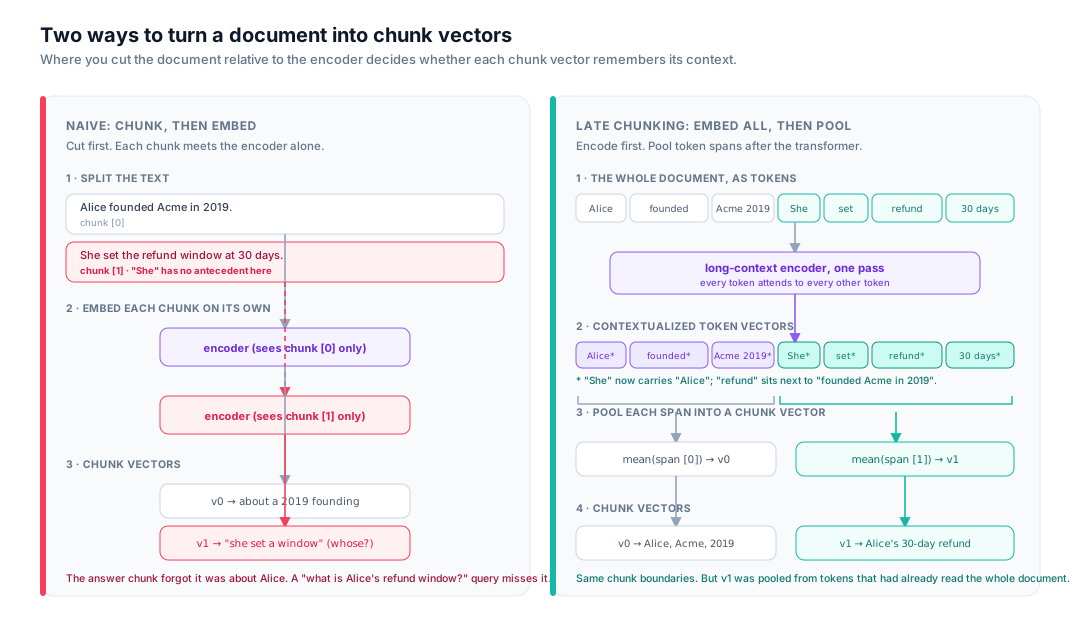
Does it actually fix our ranking? Here is the same query, “what is Alice’s refund window?”, scored against the late-chunked vectors:
   1.  0.885  [1] She set the refund window at 30 days.
   2.  0.878  [2] Returns outside that window are declined automatically.
   3.  0.424  [3] The error code E-4042 means the window has already closed.
   4.  0.394  [0] Alice founded Acme in 2019.
Chunk [1] moved from rank 2 to rank 1. The scores barely move, [1] going 0.910 to 0.885 while [2] slips from 0.915 to 0.878, but the order flips: [1]’s vector now carries a trace of “Alice” from the whole-document pass, even though the word “Alice” never appears in the chunk text, and the off-topic chunk [2] dropped below it. Same chunk text, same query, same averaging, and the right answer surfaces, purely because we pooled late.
It is important to separate this from something we did back in Part 5. There, one fix for context loss was to prepend a static title to every chunk: stick “Refund Policy” at the front of each chunk before embedding. That helps a little, but it is static and crude. It adds the same fixed string to every chunk regardless of what the chunk says, and it does nothing for sentence-to-sentence coreference like “She”. Late chunking is different in kind. It does not edit the chunk text at all. It lets the transformer’s attention do the contextualizing, so each chunk vector is shaped by the specific surrounding content, not a hand-picked header. Nothing is prepended, nothing is trained, and the model is one you already have, as long as it has a long-enough context window.
Contextual Retrieval
The second fix comes from Anthropic, who call it Contextual Retrieval. Where late chunking changes when you pool, Contextual Retrieval changes what you embed, and it does so with a small, very explicit step.
For each chunk, before embedding, you ask a language model to write one short situating sentence that says where this chunk sits in its document. For our refund note, the model might write: “This chunk is from a note about Alice and Acme’s refund policy.” Then you prepend that sentence to the chunk and embed the combination. The chunk that used to be the bare “She set the refund window at 30 days” is now embedded as “This chunk is from a note about Alice and Acme’s refund policy. She set the refund window at 30 days.” The pronoun “She” now has its antecedent sitting right next to it in the very text being encoded. The embedding model, even an ordinary short-context one, sees “Alice” and “refund policy” while it encodes the chunk, so the resulting vector points toward the right kind of query.
The recipe is prepend-then-embed, and the only moving part that is not in your existing pipeline is the model call that writes the situating sentence. In the companion code this is done with an offline, deterministic stand-in that builds the situating sentence from the document, so the whole thing runs without a network. In production you would use a real language model with a prompt like “Here is a document. Here is a chunk from it. Write a short sentence situating this chunk within the document,” and you would store the situated text.
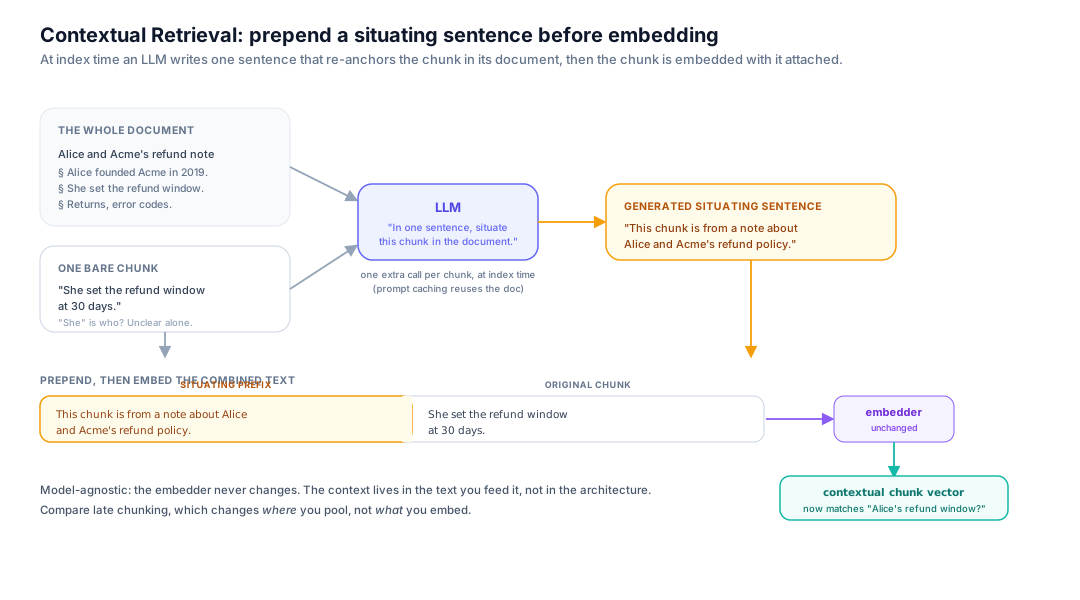
Here is the same query against the contextually-retrieved vectors:
   1.  0.973  [1] She set the refund window at 30 days.
   2.  0.968  [2] Returns outside that window are declined automatically.
   3.  0.700  [3] The error code E-4042 means the window has already closed.
   4.  0.631  [0] Alice founded Acme in 2019.
Chunk [1] is at rank 1 again, with the highest score of any approach we have tried, 0.973. The prepended sentence pulled “Alice” and “refund policy” directly into the text the embedder encoded, so the chunk vector aligns strongly with the query. Notice that every chunk’s score rose, because every chunk now carries the shared situating context; the background chunks [0] and [3] climbed the most, while [1] keeps its lead because the situating sentence resolved exactly the ambiguity that was hurting it.
One detail worth flagging, because it is the difference between this and the toy version: the situating sentence is generated per chunk, from the chunk plus its document, not a single fixed header for the whole file. That is what makes it richer than the Part 5 static-title trick. A chunk about damaged goods gets a sentence about damaged goods; a chunk about the refund window gets a sentence about the refund window. It is a small, targeted note, written for that chunk.
What the evidence actually says
This is the section where I have to be disciplined, because Contextual Retrieval has some splashy numbers attached to it and most of them do not mean what people quote them to mean.
Here is the one figure I will stand behind. In Anthropic’s own evaluation, using contextual embeddings alone, the kind we just built, prepend a situating sentence then embed, cut the top-20 retrieval failure rate by 35%, from 5.7% down to 3.7%. “Top-20 retrieval failure rate” means: out of the queries you run, what fraction fail to surface the right chunk anywhere in the top 20 retrieved. Dropping that from 5.7% to 3.7% is a real, meaningful improvement, and it is attributable specifically to the contextual-embedding step.
What I will not quote, and what you should be wary of seeing quoted, are the bigger cumulative numbers floating around. Those larger reductions are not the effect of contextual chunking alone. They bundle in other components on top of the contextual embeddings. Anthropic reports that adding Contextual BM25, the sparse-retrieval twin that indexes the same situated text in a keyword index, brings the reduction to 49% (5.7% down to 2.9%), and stacking a reranking stage on top of both pushes it to 67% (down to 1.9%). Those are real numbers for the full stack, and the 49% in particular is the figure people most often misattribute to contextual chunking by itself. It is not: it is contextual embeddings plus contextual sparse retrieval. The number for the dense-embedding technique in this essay, on its own, is 35%. When you read about this method, check whether a quoted improvement is the contextual-embedding step alone or the whole pipeline. For the technique we built here, the honest figure is 35%, 5.7% to 3.7%.
Now the honest cost. Contextual Retrieval is not free, even though it is cheap. It requires one language-model call per chunk at index time, to write each situating sentence. If you have a hundred thousand chunks, that is a hundred thousand small generation calls before you have indexed anything. That sounds alarming, and it is the most common objection, but two things soften it. First, it is a one-time, offline, index-time cost, not a per-query cost, so it does not touch your serving latency at all. Second, prompt caching makes it dramatically cheaper in practice: the document text is the same across all of its chunks, so you cache the document once and only pay for the small per-chunk variation. The situating sentences are short, the document is cached, and the bill is far lower than the raw chunk count suggests. It is still a real cost line, and you should budget for it, but it is an index-time line, not a query-time one.
Two fixes, one problem
Step back and look at the two methods side by side, because they are solving the identical disease from opposite ends of the pipeline.
Anthropic’s Contextual Retrieval works on the text, before the encoder. For each chunk you ask a language model to write a short situating blurb, roughly 50 to 100 tokens, that says where the chunk sits in its document, and you prepend that blurb before you embed. Anthropic pairs this with a second, sparse-retrieval twin they call Contextual BM25: you run the same situated text through a BM25 keyword index too, so the prepended context helps lexical matching as much as it helps the dense vector. The contextual-embedding step alone is the technique we built here; adding the contextual sparse twin is the combination Anthropic reports the bigger number for.
Jina’s late chunking works inside the encoder, on the token vectors, and it touches no text at all. You embed the whole document through a long-context encoder so every token attends to every other token, then mean-pool each chunk’s token span afterward. There is no language model, no prompt, no generation: it is training-free, a reordering of two operations you already perform. That is its whole appeal. The cost is that it leans entirely on the encoder’s context window being long enough to hold the document.
Which brings up the number that quietly decides whether late chunking is even available to you: the token budget. The short-context embedding model we have used since Part 6, all-MiniLM-L6-v2, caps at 256 tokens, a couple of paragraphs at most, so it cannot hold a whole document in one pass and cannot do late chunking at all. Jina’s long-context encoders handle around 8192 tokens, a factor of roughly thirty more, which is what makes the whole-document forward pass possible in the first place. If your encoder is short-context, late chunking is simply off the table and Contextual Retrieval, which fixes the text rather than relying on the window, is your move. If your encoder is long-context, late chunking is close to free.
There is a sharp failure mode hiding in that token budget: silent truncation. If you hand a whole document to a 512-token model expecting late chunking, the encoder does not warn you, it just throws away everything past its window, and the chunks that fell outside it come back as garbage vectors. The fix is a one-line habit: check the encoder’s max sequence length before you reach for late chunking, because late chunking is only ever as good as the window you pour the document into.
One more thing, and it is the same instinct from Part 9: what you store and index is not what you have to serve. Both fixes change the vector (and, for Contextual Retrieval, the text) that you index and search against, the situated text or the late-pooled embedding. They do not oblige you to hand that doctored text to the generator. You can index the context-aware vector for sharp retrieval and still feed the model the original, clean chunk, with no prepended blurb cluttering the prompt. The situating sentence earns its keep at index time, where matching happens, and then gets out of the way at generation time. The companion code closes on exactly this reminder. Decoupling the indexed unit from the served unit is the through-line of the back half of this series, and context-aware chunking is one more place it pays off.
Choosing and combining
So we have two fixes for the same disease. How do you pick?
Late chunking needs a long-context encoder, an embedding model whose window is long enough to hold a whole document in one pass, but it needs no language model at all. There is no generation step, no extra prompt, no per-chunk call. You pay a bit more at encode time because you run the whole document through the transformer at once, and then the pooling is free. If you already have a long-context embedding model, late chunking is close to a free upgrade: same model, you just pool late.
Contextual Retrieval is the opposite trade. It is model-agnostic on the embedding side, it works with any embedder, even a short-context one, because it fixes the chunk text itself rather than relying on the encoder’s window. But it costs that language-model call per chunk at index time. It is a drop-in if you already have a generation model wired up and your embedder is short-context.
Here is the comparison at a glance:
| | Late chunking | Contextual Retrieval | |---|---|---| | What it changes | When you pool (after the encoder) | What you embed (prepend a situating sentence) | | Order of operations | Embed all tokens, then pool spans | Generate a note, prepend, then embed | | Needs a long-context encoder | Yes | No, works with any embedder | | Needs a language model | No | Yes, one call per chunk at index time | | Main cost | Larger encode pass over the whole document | Index-time LLM calls (prompt caching mitigates) | | The number to know | (no headline figure to quote) | 35% top-20 failure reduction (5.7% to 3.7%) |
And the most useful thing to know: they compose. They fix the context-loss problem at different stages, late chunking inside the encoder’s attention, Contextual Retrieval in the text before the encoder, so you can do both. Run a long-context encoder over a document whose chunks have each been prepended with a situating sentence, and pool late. There is no conflict. The interactive widget below lets you flip between naive chunking, late chunking, and Contextual Retrieval over the same refund note and watch which chunk gets retrieved under each. The right answer, chunk [1], is buried at rank 2 under naive chunking and surfaces to rank 1 under both fixes.
💡 From experience. The first time this bit me, it was not a pronoun, it was a table. We had chunked a long benefits handbook one section per chunk, and a chunk listing dollar amounts under a heading like “Tier 2” embedded into something almost unsearchable, because the chunk text was just numbers and the words “Tier 2”, with no mention of what plan or what benefit those numbers belonged to. Users asking “how much is the dental copay on the premium plan” never got that chunk in the top results, and I spent an afternoon convinced our embedding model was broken. It was not. The chunk had simply lost its context the instant we sliced it out, exactly the failure in this essay. The fix that shipped was the cheap one: a per-chunk situating sentence, generated once at index time, prepended before embedding. Top-20 recall on that handbook jumped noticeably, and the lesson stuck with me, when retrieval mysteriously misses an obvious chunk, read the chunk as the embedder sees it, alone, stripped of everything around it, and ask whether you could answer the query from that text and nothing else. Half the time the answer is no, and the chunk never had a chance.
Try it yourself
You do not need a long-context encoder to feel Contextual Retrieval work, because the text edit it makes is something you can do by hand. Open the companion code, context_aware_chunking.py, and run it with no arguments. The offline path is deterministic, so you will get the numbers from the prose every time: under naive chunking the answer chunk [1] sits at rank 2, buried by the off-topic [2], and both fixes lift it to rank 1.
Now make the situating sentence yourself and watch the ranking move:
- Take the bare chunk
"She set the refund window at 30 days."and the query"what is Alice's refund window?". Score them under naive chunking and note where[1]lands. - Prepend a one-sentence blurb that names the antecedent:
"This chunk is from a note about Alice and Acme's refund policy. She set the refund window at 30 days."Re-embed and re-score. The pronoun now has “Alice” sitting right next to it in the encoded text, and[1]climbs. - Change the blurb. Try a vague one that names the wrong thing, like
"This is a document about shipping.", and watch the gain evaporate or even reverse. The lift comes from the blurb actually resolving the ambiguity, not from prepending any text. This is why the per-chunk note matters more than a static title. - If you have a long-context encoder installed (jina), run with
--onlineand compare. A strong real encoder may already rank[1]first under naive, in which case the trap does not bite on that run and the script tells you so. That is the honest situation from the prose: the trap is real but intermittent, and the offline path is where it reliably shows.
The whole exercise takes a few minutes and it makes the mechanism physical: you are editing the text the embedder reads, and you can watch the cosine score for the answer chunk rise as the situating sentence does its job.
⚠️ Common pitfalls.
- Offset-mapping bugs in late chunking. The entire correctness of late chunking lives in carving the document’s token-vector sequence back into the right per-chunk spans. Off-by-one on the token offsets, forgetting that the tokenizer inserts special tokens like
[CLS]and[SEP], or letting a sub-word token straddle a chunk boundary, and you pool the wrong vectors into the wrong chunk. The pooling math is trivial; the bookkeeping is where it breaks. Use the tokenizer’s own offset mapping rather than re-tokenizing chunks separately.[CLS]-pooled models that never expose token vectors. Late chunking needs the per-token output of the encoder. Many embedding models hand you only the pooled sentence vector (a[CLS]token or an internal mean) and give you no way to reach the underlying token vectors. On those models late chunking is simply not implementable, no matter how long the context window is. Check that your model exposes token embeddings before you plan around it.- Situating-sentence hallucination. The blurb in Contextual Retrieval is written by a language model, and a language model can invent facts. If the model writes “This chunk is from the 2023 premium-plan policy” when the document never said premium or 2023, you have just embedded a confident lie, and it will pull queries toward the wrong chunk. Keep the prompt tightly scoped to the document, prefer extractive over inventive phrasing, and spot-check the generated sentences.
- Confusing what you store with what you serve. The doctored text (the prepended blurb) and the doctored vector (the late-pooled embedding) belong at index time. If you also feed the situating sentence to the generator you have padded every prompt with redundant boilerplate, wasting tokens and sometimes confusing the model. Index the context-aware representation; serve the original chunk.
Key takeaways
- A chunk that reads fine inside its document can be uninterpretable once embedded alone. Coreference is the usual culprit: “She”, “the policy”, “that error” lose the antecedents that gave them meaning, and the chunk’s vector stops pointing at the queries it should answer. In our refund note, the answer chunk “She set the refund window at 30 days” got buried at rank 2 under naive chunking.
- Late chunking (Jina AI team) embeds the whole document through a long-context encoder in one pass, then pools each chunk’s token span afterward. The pooling is an ordinary mean; the difference is that the tokens being averaged already carry the document’s context. It moved the answer chunk to rank 1, with no text edits and no language model.
- Contextual Retrieval (Anthropic) prepends a short, LLM-written situating sentence to each chunk before embedding, so the antecedent sits right next to the pronoun in the text the embedder encodes. It also moved the answer chunk to rank 1, and it is the richer cousin of Part 5’s static title-prepend because the note is written per chunk.
- The one defensible quantitative claim is that contextual embeddings alone cut top-20 retrieval failure by 35% (5.7% to 3.7%). Bigger cumulative numbers you may see bundle in sparse retrieval and reranking; do not attribute those to contextual chunking by itself.
- Late chunking needs a long-context encoder but no language model; Contextual Retrieval is model-agnostic on the embedder but costs one LLM call per chunk at index time, which prompt caching makes cheap and which never touches serving latency. They fix the problem at different stages, so they compose. This field moves fast and I have a knowledge cutoff, so treat the specific figures and model names here as a snapshot and verify the current state.
References
- Anthropic, “Introducing Contextual Retrieval” (2024). The source for Contextual Retrieval, Contextual BM25, and the failure-rate numbers quoted here: 35% for contextual embeddings alone (5.7% to 3.7%), 49% adding Contextual BM25 (to 2.9%), 67% adding reranking (to 1.9%). https://www.anthropic.com/news/contextual-retrieval
- Günther, M., Mohr, I., Williams, D. J., Wang, B., and Xiao, H., “Late Chunking: Contextual Chunk Embeddings Using Long-Context Embedding Models,” arXiv:2409.04701 (2024). The late-chunking paper from the Jina AI team, including the long-context encoders (around 8192 tokens) the method relies on. https://arxiv.org/abs/2409.04701
Glossary
- Coreference: when a word refers to something named elsewhere, such as a pronoun (“she”, “it”, “that window”) standing in for an antecedent introduced earlier in the text.
- Context loss: the failure where a chunk that is interpretable inside its document becomes ambiguous or meaningless once sliced out and embedded on its own, because the surrounding text that disambiguated it is gone.
- Long-context encoder: an embedding model whose context window is long enough to encode a whole document (or a large span of one) in a single forward pass, so every token attends to every other token.
- Late chunking: embedding an entire document through a long-context encoder first to get contextualized per-token vectors, then pooling each chunk’s token span into a chunk vector afterward, so each chunk vector is shaped by the whole document.
- Contextual Retrieval: for each chunk, using a language model to write a short situating sentence describing where the chunk sits in its document, prepending that sentence to the chunk, and embedding the combination.
- Situating sentence: the short, per-chunk note that Contextual Retrieval generates and prepends, naming the document and the chunk’s place in it so the embedder sees the missing context.
- Top-20 retrieval failure rate: the fraction of queries for which the correct chunk does not appear anywhere in the top 20 retrieved results; a standard way to measure how often retrieval misses.
- Prompt caching: reusing the cached encoding of repeated prompt content (here, a document shared across all of its chunks) so you only pay for the small per-call variation, sharply lowering the cost of per-chunk generation.
Next up, Part 15: Adaptive RAG. We have made each chunk carry its context, but we still run one fixed pipeline for every query, the same machinery for a greeting and for a multi-part comparison. Next we add a small complexity classifier that routes each query to no-retrieval, single-step, or multi-step retrieval, the conductor over the pipelines we built across Parts 6 to 10, and the close of the Frontier Track.